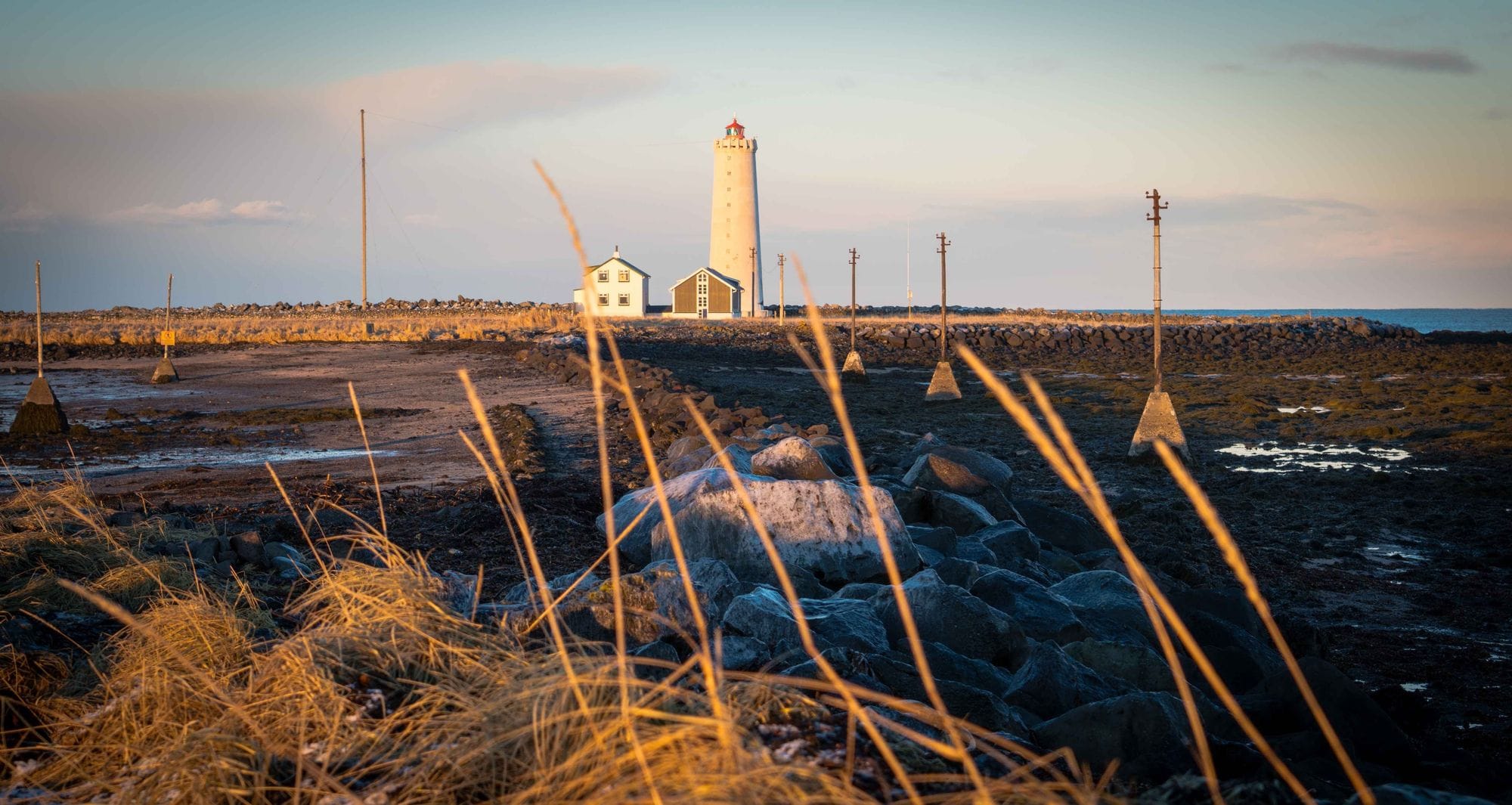
Much of Grótta’s shoreline has been reinforced in response to land subsidence, giving the island the shape of a shallow bowl. To protect nesting birds, access to the area is prohibited from 1 May to 15 July.
Despite having relatively few habitat types and plant species, the island is lush and well vegetated. Grótta is particularly rich in birdlife. Surveys have recorded around 450 breeding pairs of Arctic terns on the island. The Arctic tern is a species for which Iceland has a particular conservation responsibility and is fully protected.
The first lighthouse at Grótta was built in 1897. For many years it was home to lighthouse keeper Albert Þorvarðarson (1910–1973), after whom the local search and rescue association, Slysavarnarfélagið á Nesinu, is named.
Grótta was also once used as a base for coastal fishing. According to local history, a boat was lost near Gróttutangi, an event remembered in this verse:
Death came seeking those who ruled the sea,
fierce was the pull among the rocks.
Uneasy is the night for those who lie
beneath Gróttutangi.
Protection Status
Grótta was designated a protected area in 1974.